
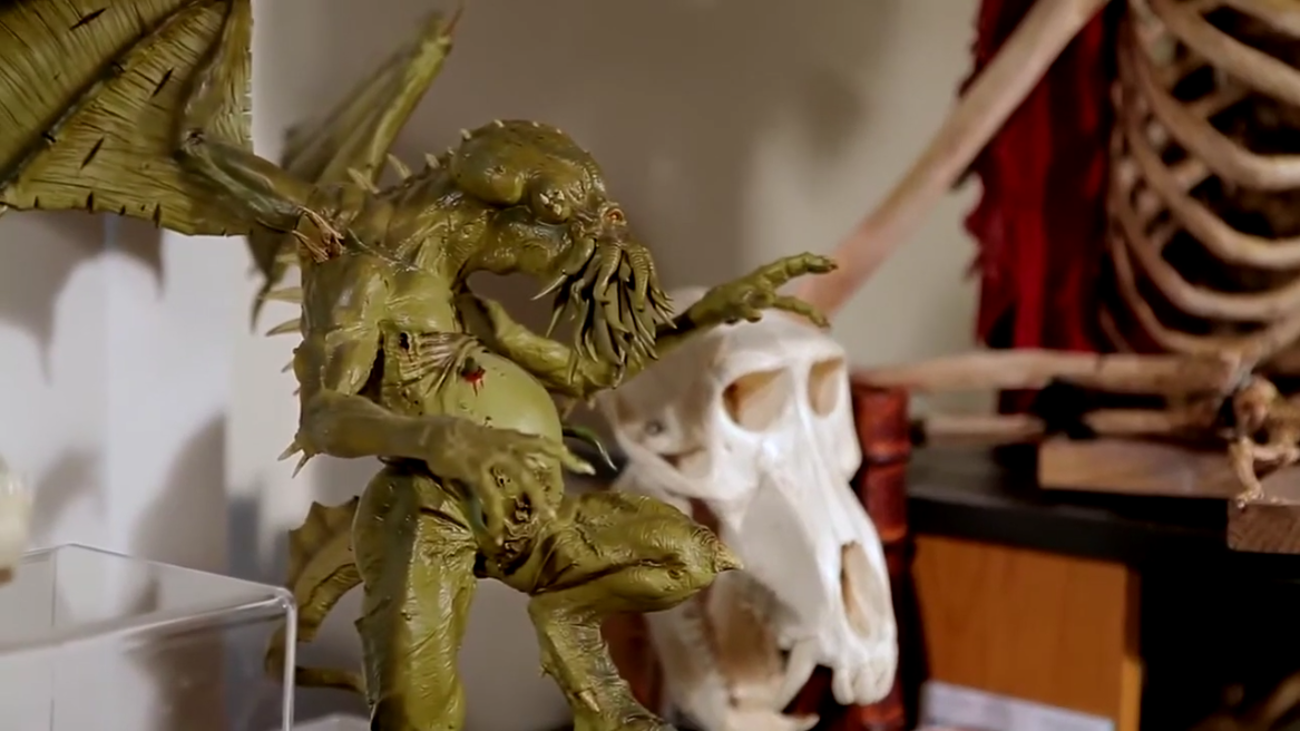
For a century, H.P. Lovecraft’s most famous cosmic horror — a madness-inducing mass of tentacles and ancient biology best left to the reader’s imagination — was deemed visually unadaptable. Then Oscar-winning makeup artist Joel Harlow put clay to armature.
The Myth of the “Unfilmable” Cosmic Horror
H.P. Lovecraft famously described Cthulhu’s associated geometry as “all wrong,” describing a blasphemous entity that defied earthly physics, human perception, and architectural logic. For decades, Hollywood treated cosmic horror as a strictly literary domain. Often, their laziness and complacency meant the moment bright, hot fill and key lights illuminate an onscreen monster, the terror of the unknown usually vanishes, replaced by rubber suits or floaty, weightless computer-generated pixels.
When digital visual effects took over mainstream genre cinema in the early 2000s, directors stopped wrestling with physical materials. CGI allowed for impossible shapes, but it stripped away texture, mass, and presence. A creature rendered entirely inside a computer rendering farm rarely feels like it occupies real air — let alone an ancient, crushing oceanic depth. To make cosmic horror truly terrifying, an artist doesn’t need infinite digital processors; they need physical weight, organic imperfection, and an absolute mastery of practical makeup FX.

The Sculpt: Clay, Texture, and Practical Craft
Enter Oscar-winning special effects makeup legend Joel Harlow (Star Trek, Pirates of the Caribbean, Hellboy 2019). When revisiting his hellish, strobe-enhanced Cthulhu sculpt on his socials, Harlow bypassed the temptation of digital pre-visualization in favor of traditional, tactile artistry. Building a physical creature of this scale requires solving complex engineering problems (complete with forced perspective) before the first layer of clay even touches the armature.
Harlow’s sculpt balances iconic cephalopod motifs — the writhing facial tentacles and chitinous, bat-like structure — with deep, unsettling anatomical realism. Every fold of translucent skin, wet membrane, and calcified encrustation feels earned. By combining silicone prosthetics, intricate hand-painted detailing, and subtle mechanical undertones, the sculpt achieves what CGI so often fails to deliver: a sense of tangible, terrifying presence that catches light naturally and carries undeniable physical mass.
Why Physical Creature Design Still Trumps CGI
Harlow’s work serves as a masterclass in why modern audiences are experiencing severe digital fatigue. When a performer interacts with a physical, three-dimensional creature on set, the camera captures genuine lighting bounce, authentic depth of field, and raw human reaction. CGI can simulate millions of polygons, but it struggles to replicate the visceral decay, moisture, and tactile weight of a physical makeup sculpt.
In an era where multimillion-dollar blockbusters blur into a weightless CGI soup, practical masterpieces like Harlow’s Cthulhu remind us why the golden age of monster cinema resonated so deeply. It proves that cosmic horror isn’t unfilmable; it just requires artists willing to get their hands covered in clay to bring ancient nightmares into the physical world. (Now if only someone with the money were willing to make a movie around this monster after seeing Harlow’s test footage, the circle would be complete.)
Leave a Reply